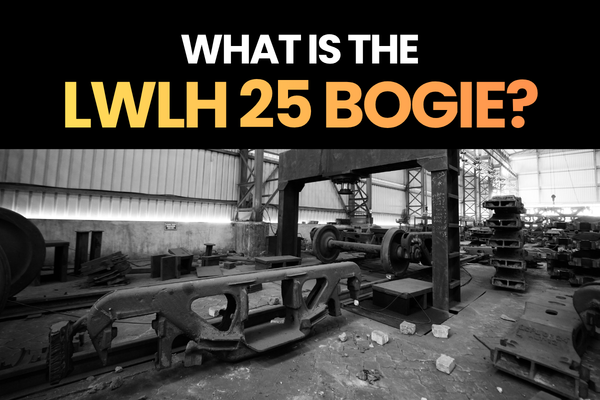
When Indian Railways designed the infrastructure for the Dedicated Freight Corridors, it made a deliberate engineering choice: the new corridors would be built to carry 25-tonne axle loads at 100 km/h.
This is significantly above the 22.9-tonne, 100 km/h capability of the CASNUB 22HS — the previous high-performance freight bogie standard. And it required a completely new bogie design to carry it reliably.
That design is the LWLH 25.
Light Weight Low Height 25T axle load (LWLH 25) Bogie Assembly Complete for BOXNS wagon, conforming to RDSO’s Specification No. WD-40-LWLH25 Bogie (K-Class) -2015 (Rev.1) Amend. No. 2 of Feb. 2021. Matrixbcg
At Loco Castings Private Limited, we manufacture the LWLH 25 bogie at our fully integrated EAF foundry in Andal, Paschim Bardhaman, West Bengal. This article is the complete reference guide for this bogie — specifications, applications, design rationale and what procurement managers need to know.
What LWLH Stands For
L — Light Weight (the complete bogie weighs 4.95 tonnes, lighter than the CASNUB 22HS at 5.4 tonnes) W — Wide Jaw (the pedestal jaw width is wider than the narrow jaw CASNUB designs) L — Low Height (the centre pivot height from rail level is 726.5mm — significantly lower than the 929–932mm of CASNUB variants) H — (some references: Low Height is the primary descriptor for this dimension) 25 — 25-tonne maximum axle load
Another low type “LWLH” type of 25T axle load bogies are the most recent design of Indian Railways. lococastings
Complete LWLH 25 Specifications
| Parameter | LWLH 25 Value |
| Maximum Axle Load | 25 tonnes |
| Maximum Speed | 100 km/h |
| Wheel Diameter (new) | 840 mm |
| Wheelbase | 2000 mm |
| Journal Centres | 2260 mm |
| CP Height from RL (under tare) | 726.5 mm |
| Complete Bogie Weight | 4.95 tonnes |
| RDSO Specification | WD-40-LWLH25 Bogie (K-Class) -2015 (Rev.1) |
| RDSO Drawing | WD-15021-S-02, Alt. 04 |
| Bogie Type | Three-piece cast steel |
| Bearing Type | K-Class CTRB (6½” × 9″) |
Why the Lower Centre Pivot Height Matters
The 726.5mm CP height of the LWLH 25 versus 929–932mm for CASNUB variants is the defining design difference — not just a dimension change.
When a loaded wagon runs through a curve at speed, centrifugal force acts on the wagon body’s centre of mass. The higher the centre of mass above the rail, the larger the overturning moment — the tendency for the wagon to roll outward through the curve.
Reducing the CP height lowers the wagon body, which lowers the centre of gravity of the loaded wagon. A lower centre of gravity means:
- Smaller overturning moment for a given speed and curve radius
- More stable operation at 100 km/h with 25 tonnes per axle
- More margin between operating speed and the speed at which wheel lift would occur
The LWLH 25 achieves 25-tonne axle load at 100 km/h specifically because the low CP height keeps the centre of gravity low enough for safe high-speed operation. The CASNUB 22HS cannot simply be rated to 25 tonnes — its higher CP height would create an unacceptable stability margin at 100 km/h with that axle load.
Which Wagons Use the LWLH 25?
The LWLH 25 is the standard bogie for new-build freight wagons targeting Dedicated Freight Corridor operations. Current and planned wagon types:
BOXNS — The standard open box wagon for 25T axle load. Coal, iron ore, mineral bulk. The RDSO tender referenced earlier specified LWLH 25 bogies specifically for BOXNS wagons.
High-capacity covered wagons — New-build BCN variants targeting DFC capacity
High-capacity tank wagons — For petroleum products on DFC petroleum corridors
Container flat wagons — Container service on DFC where low floor height is also beneficial
Any new-build wagon specified for full DFC capacity operations (25T, 100 km/h) must use the LWLH 25. This is not a commercial choice — it is a physics requirement enforced by RDSO specifications.
The K-Class Bearing — Why It Differs from the E-Class
CASNUB bogies use the Class E CTRB (6″ × 11″). The LWLH 25 uses the Class K CTRB (6½” × 9″).
The Class K bearing has a larger bore diameter (to accommodate the higher axle load) but shorter length. The journal diameter is correspondingly larger. Three sources have been approved by AAR for Class K bearing supply in India: National Engineering Industries, SKF India, and Timken India.
The wider journal and Class K bearing are what enable the LWLH 25 to carry 25-tonne axle loads — the bearing size is matched to the journal contact stress requirements at that load level.
This is why the LWLH pedestal geometry — the wide jaw — is different from the CASNUB narrow jaw: it accommodates the larger K-Class bearing assembly.
LCPL’s LWLH 25 Manufacturing Process
The LWLH 25 is manufactured at our Andal foundry using our complete integrated process. Key process points specific to the LWLH 25:
Mould geometry: The LWLH 25 bolster’s lower profile requires careful No-Bake mould design to achieve consistent wall thickness and feeding to all sections. Our solidification simulation verifies the gating before production.
Pedestal machining: The wide jaw pedestal opening is machined on our CNC machines to the dimensional tolerance required for K-Class CTRB fit. Pedestal width, height and alignment are all verified.
CP height verification: The CP height from the base of the side frame to the bolster bowl top face is a critical dimension for the wagon underframe interface. This is dimensionally verified on every bogie set.
Weight verification: The 4.95-tonne complete bogie weight is a specification item. Consistent casting weight indicates consistent dimensional and material control.
For complete LWLH 25 specifications and supply enquiries, contact sales@lococastings.in or visit our products page.
FAQ — LWLH 25 Bogie
Yes. The LWLH 25 can operate on conventional broad gauge track. However, the maximum permissible axle load on conventional track sections is lower than 25 tonnes — the wagon must operate at restricted load on non-DFC sections. The DFC’s advantage is that it permits the full 25T throughout its length.
WD-40-LWLH25 Bogie (K-Class) -2015, Revision 1, Amendment No. 2 of February 2021. The assembly drawing reference is WD-15021-S-02, Alt. 04.
The lower CP height reduces the structural section depth of the bolster. The optimized casting geometry — based on finite element analysis — achieves the required strength at lower material weight than the older CASNUB bolster design. Lighter tare weight means more payload per wagon for a given gross rail load.
No. The LWLH wedge is a different geometry from the HS wedge — it is designed for the LWLH 25’s lower bolster profile and 25-tonne contact forces. They are not interchangeable. LCPL manufactures both LWLH wedges and HS wedges as separate products.
Yes. LCPL supplies LWLH pivot castings as standalone components. Contact sales@lococastings.in for specifications and pricing.
The LCCF 20 (Low profile Container Car bogie) is a different design used for container flat wagons. It shares the low height principle with the LWLH 25 but has different axle load rating, wheel diameter, and structural geometry. The LCCF 20 is used for 20-tonne axle load container operations; the LWLH 25 is for 25-tonne heavy bulk freight.