Most railway procurement conversations in India revolve around three names — CASNUB 22HS, CASNUB 22NLB, and LWLH 25. These are the three-piece cast steel bogies that carry the vast majority of Indian Railways’ freight wagon fleet.
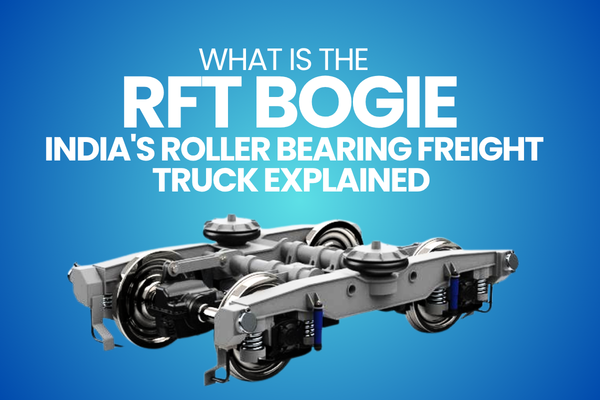
The RFT bogie — Roller Bearing Freight Truck — occupies a smaller but distinct segment of the freight bogie market. It is not a newcomer, and it is not a replacement for the CASNUB family. It is a different engineering choice that makes sense in specific operating contexts — and understanding when and why matters for procurement managers, wagon builders and maintenance engineers.
Loco Castings Private Limited manufactures the RFT bogie at our fully integrated EAF foundry in Andal, Paschim Bardhaman, West Bengal.
The Core Difference: Roller Bearings vs the Wedge-Adapter System
In a standard CASNUB bogie, the wheel axle journal sits in an adapter — a cast steel block that sits in the side frame pedestal and transfers the load from the axle to the side frame. The adapter can move slightly in the pedestal as the bogie negotiates curves and track irregularities.
The friction wedge damping system — described in detail in our friction wedge guide — manages the vertical dynamics.
In the RFT bogie, the axle journal carries a Cartridge Tapered Roller Bearing (CTRB). The CTRB is a preassembled unit — two inner races (cones) with rollers and cage, a single outer race (cup), grease seals and a seal-wear ring, all contained in a sealed cartridge. This cartridge fits directly into the side frame pedestal journal opening without an adapter.
The difference matters in three ways:
Rolling friction vs sliding friction: A CTRB generates rolling friction at the journal — far lower than the sliding friction between adapter and journal in the conventional arrangement. This reduces rolling resistance, particularly at low speeds and during starting.
Sealed, maintenance-free lubrication: The CTRB is factory-lubricated and sealed for its entire design life. It does not require the regular hot box prevention greasing that conventional plain bearing journals need. This reduces depot maintenance workload and eliminates hot box failures caused by inadequate lubrication.
No adapter wear: Conventional adapters wear at the crown — the contact surface between adapter and journal. Worn adapters require replacement and can contribute to journal wear. The CTRB eliminates this wear mode entirely.
Which Wagons Use the RFT Bogie?
The RFT bogie is used on wagons where the combination of lower rolling resistance, sealed bearing reliability and reduced maintenance is specified by RDSO or the wagon owner. Common applications include:
- BOXN wagons — some variants specify CASNUB bogies with CTRB adapters rather than plain adapters; the fully integrated RFT arrangement takes this further
- Tank wagons (BTPN) — long-haul petroleum product wagons where bearing reliability over extended runs is critical
- High-value commodity wagons — where maintenance interval extension justifies the initial cost premium
- Export wagons — wagons built for international rail networks outside India where roller bearing standards are mandated
The IRFCA documentation notes that BOXN wagons feature AAR ‘E’ high-tensile couplers with high-capacity draft gear and CASNUB 22NLB cast steel bogies with cartridge tapered roller bearings. This hybrid — CASNUB side frames and bolster with CTRB instead of plain adapters — represents one version of the roller bearing approach. The fully integrated RFT bogie takes the roller bearing design from the outset. Indian Railways
RFT vs CASNUB — When to Choose Which
| Factor | CASNUB 22HS / 22NLB | RFT Bogie |
| Bearing type | Plain adapter (sliding) | Cartridge tapered roller bearing |
| Rolling resistance | Higher | Lower — approx. 30–40% reduction |
| Hot box risk | Present — requires monitoring | Eliminated |
| Maintenance interval | Adapter inspection at POH | CTRB designed for extended life |
| Initial cost | Lower | Higher (bearing cost) |
| Spare parts availability | Very high across India | Depends on bearing sourcing |
| Application fit | General freight, short to medium haul | Long-haul, high-reliability requirement |
The CASNUB remains the right choice for the majority of Indian Railways freight applications — its spare parts ecosystem is mature, its maintenance practices are well-established across thousands of depot staff, and its cost per bogie is lower.
The RFT makes sense when:
- The wagon operates on long-haul, high-frequency runs where bearing reliability is critical
- The wagon owner has maintenance facilities equipped for CTRB servicing
- Route profile and commodity make the hot box risk a meaningful concern
- Export requirements mandate roller bearing standards
The CTRB in the RFT Bogie — Technical Notes
The Cartridge Type Taper Roller Bearing (CTRB) has two inner races (cones) along with rollers and cage, separated by a spacer, a single case-hardened outer race (cup), a grease seal and a seal-wear ring at each end, a backing ring at the rear. BEC Foundry
For the RFT bogie used in Indian Railways freight applications, the Class E (6″×11″) CTRB is the standard — weighing approximately 34.3 kg. The narrow jaw adapter used with Class E bearings weighs approximately 12.0 kg.
The bearing must be fitted to the axle journal with controlled press-fit force. Over-press or under-press leads to premature bearing failure — a workshop quality issue, not a bearing or bogie design issue. Correct CTRB fitting practice is specified in RDSO maintenance instructions and must be followed precisely.
LCPL’s RFT Bogie Manufacturing
LCPL manufactures the RFT bogie side frames and bolster using the same fully integrated process used for CASNUB and LWLH components:
- 5-tonne Electric Arc Furnace with argon purging
- No-Bake sand casting for dimensional accuracy
- In-house heat treatment
- CNC machining of journal pedestal opening dimensions — critical for CTRB fit
- In-house spectrometry and mechanical testing
The journal pedestal opening in the RFT side frame is machined to tighter tolerances than in a plain adapter CASNUB side frame, because the CTRB outer race fits directly into the pedestal. Dimensional accuracy here is not optional — an out-of-tolerance pedestal causes uneven CTRB loading and premature bearing failure.
Visit our facilities page for details of our manufacturing capability. For RFT bogie specifications and supply enquiries, contact sales@lococastings.in.
Frequently Asked Questions — RFT Bogie
RFT stands for Roller Bearing Freight Truck. It refers to a three-piece cast steel freight bogie that uses cartridge tapered roller bearings at the axle journal rather than the plain adapter arrangement of standard CASNUB bogies.
Yes. The RFT bogie and its component specifications are covered under RDSO drawing and specification documents. LCPL holds RDSO approval for our bogie manufacturing. Contact us for current approval documentation.
CASNUB bogies can be fitted with CTRB adapters — the bearing sits in a special adapter that fits the standard pedestal opening. This is different from a fully integrated RFT bogie where the pedestal is machined specifically for direct CTRB fit. Consult RDSO maintenance instructions for the correct retrofit procedure.
CTRBs are designed for extended service life — typically 10–15 years or defined km intervals under specified operating conditions. Actual life depends on correct fitting, wagon loading, and route profile. RDSO maintenance manuals specify inspection and replacement criteria.
LCPL manufactures the cast steel components of the RFT bogie — side frames and bolsters. Contact sales@lococastings.in to discuss your specific supply and assembly requirements.